

Read the differences first, then decide which venue deserves the registration path.
Trading platform deep comparison
Bybit vs Hyperliquid: fees, products and KYC side by side
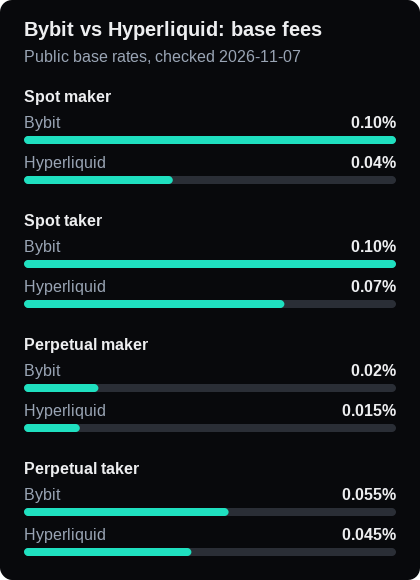
Hyperliquid has the lower spot taker fee: 0.07% against 0.10% at Bybit. Hyperliquid has the lower perpetual taker fee: 0.045% against 0.055% at Bybit. Standard-tier rates, checked 2026-11-07.
Bybit
Spot fee gap, percentage points
Hyperliquid is lower on Spot maker
Spot fee gap, percentage points: 0.06 pp. Hyperliquid is lower on Spot makerHyperliquid
Bybit: 0.10%Spot makerHyperliquid: 0.04%
Bybit: 0.10%Spot takerHyperliquid: 0.07%
Bybit: 0.02%Perp makerHyperliquid: 0.015%
Bybit: 0.055%Perp takerHyperliquid: 0.045%
Bars share one scale across every venue, 0 to 0.80%
The short answer: Bybit charges 0.10% spot taker and 0.055% perpetual taker; Hyperliquid charges 0.07% and 0.045%. On 100,000 USDT of futures, taker fees are $55 vs $45. With our sign-up codes, up to 30% of Bybit fees and up to 30% of Hyperliquid fees come back. Fees from the bybit.com and hyperliquid.gitbook.io official fee pages, as of 2026-11-07.
Generated from NexuAlpha's reviewed data on 2026-11-07 — no editorial verdict. Figures we have not checked stay marked as not verified.
- BybitPartner rebate share: Up to 30%
- HyperliquidPartner rebate share: Up to 30%Lower fees
Read the differences first, then decide which venue deserves the registration path.
Line by line
Best for
- Best for lowest checked fees
- Hyperliquid
Verified spot taker; maker breaks ties.
- Best for most top-200 coins
- Bybit
Top-200 listings in coin data.
- Best for futures
- Hyperliquid
Choose the lowest checked futures taker fee, then maker fee; funding matrix participation is descriptive only.
- Best for beginners (funding / fee proxy)
- Hyperliquid
Reviewed local funding guide first, then lowest spot fee.
Show rules, dates and sourcesHide rules, dates and sources
Scroll horizontally to compare all exchanges
| Dimension | Bybit | Hyperliquid |
|---|---|---|
| Fees | ||
| Lowest checked spot feesVerified spot taker; maker breaks ties. | 0.10% / 0.10%As of 2026-11-07 SGTBybit fee schedule | 0.04% / 0.07%WinnerAs of 2026-11-07 SGTHyperliquid fee schedule |
| Lowest checked futures feesVerified futures taker; maker breaks ties. | 0.02% / 0.055%As of 2026-11-07 SGTBybit fee schedule | 0.015% / 0.045%WinnerAs of 2026-11-07 SGTHyperliquid fee schedule |
| Coins & products | ||
| Most top-200 coin availabilityTop-200 listings in coin data. | 140 of top-200WinnerAs of 2026-10-12 SGTNexuAlpha /coins | NexuAlpha /coins |
| Funding-rate matrix participationShows participation in the reviewed funding-matrix universe; no live observed pair count is inferred. | Included in funding-rate matrixNexuAlpha /funding-rates | Included in funding-rate matrixNexuAlpha /funding-rates |
| Best for futuresFutures evidence comes from checked futures fee facts. | YesTieAs of 2026-11-07 SGTBybit fee schedule | YesTieAs of 2026-11-07 SGTHyperliquid fee schedule |
| Regions & licences | ||
| Official register entriesEntries from the official-register directory (/licenses); statuses differ by regulator, so no venue wins this row. | AMF (FR): licensed; BaFin (DE): licensed; FMA (AT): licensed; CNV (AR): registered; Austrian Financial Market Authority (FMA) (EU): licensed; SFC (HK): applied; FIU-IND (IN): registered; Japan FSA (JP): warning; SPK (TR): appliedAs of 2026-10-14 SGTamf-france.orgportal.mvp.bafin.deesma.europa.eucnv.gov.arsfc.hksansad.infsa.go.jpspk.gov.tr | |
Side-by-side numbers+
Verify eligibility before the official flow
Only verified links open, each to the official site.
Fees, Rebates, Reserves & Limits Comparison
Each row links its official source; anything unchecked is marked.
Fees checked 2026-11-07
Swipe the matrix sideways to compare all columns.
Side-by-side numbers | Bybit CEX | Hyperliquid Perp DEX |
|---|---|---|
| Spot maker / taker feeStandard spot trading fees | 0.10% / 0.10%Regular userUses Bybit's VIP 0 row for Spot Trading (Crypto-Crypto). Fiat spot pairs, Adventure Zone, xStocks, derivatives, options, Pro, VIP and market-maker schedules are excluded; final rates can vary by region and logged-in My Fee Rate after identity verification. View fee source ↗ | 0.04% / 0.07%Regular userDated public base rate; account terms can differ. View fee source ↗ |
| Futures maker / taker feeStandard perpetual futures fees | 0.02% / 0.055%Regular userDated public base rate; account terms can differ. View fee source ↗ | 0.015% / 0.045%Regular userDated public base rate; account terms can differ. View fee source ↗ |
| Proof of Reserves (PoR)Merkle-tree reserve verification | Official page linked, figures not yet reviewedView audit report ↗ | Official page linked, figures not yet reviewedView audit report · hyperliquid.xyz |
| Official actionCheck official account terms and sources |
Pre-registration verdict
Decide which venue fits first
BybitCEX
- Better for
- Choose Bybit when derivatives, copy-trading checks and product-specific fee tables matter more than a simple spot-only account.
- Before registration
- The official KYC FAQ says Standard identity verification is mandatory, and the fee source separates maker and taker roles by product type.
- Not ideal for
- Avoid assuming anonymous access, universal copy trading, or local derivative eligibility; all depend on account, product and region checks.
- Consider instead
- Hyperliquid
HyperliquidPerp DEX
Review verification details and limits
- Better for
- Verify public products, regional eligibility and official fees first
- Before registration
- Only source-linked facts with a review date are publishable
- Not ideal for
- Regional restrictions, account eligibility and campaign terms need official verification
- Consider instead
- Bybit
Review fees, reserves and KYC
Bybit
CEXChoose Bybit when derivatives, copy-trading checks and product-specific fee tables matter more than a simple spot-only account.
Review fees, reserves and KYC
Spot Fee0.10% / 0.10% (maker / taker) · Regular user · Bybit normal-zone crypto-to-crypto spot base rangeUses Bybit's VIP 0 row for Spot Trading (Crypto-Crypto). Fiat spot pairs, Adventure Zone, xStocks, derivatives, options, Pro, VIP and market-maker schedules are excluded; final rates can vary by region and logged-in My Fee Rate after identity verification. View fee source ↗
Bybit Official References & Sources+
Bybit Official References & SourcesRead terms and sources →
- •Complete the required identity verification before claiming.
- •Complete and claim each task before its own deadline.
Bybit Rewards Hub FAQBybit · CPUSDT perpetual announcement · announcements.bybit.comOpen independent profile (Bybit) →
Hyperliquid
Perp DEXReview fees, reserves and KYC
Spot Fee0.04% / 0.07% (maker / taker) · Regular user · Base rate from the official fee pageDated public base rate; account terms can differ. View fee source ↗
Hyperliquid Official References & Sources+
Hyperliquid Official References & SourcesRead terms and sources →
- •A valid referral code or link must be applied. This research panel does not include referral codes; the sign-up cards on this site do.
- •The fee discount stops after the referred account's first $25 million in volume; vaults and sub-accounts do not inherit it.
Open scenario fit and next steps
PRE-SIGNUP DECISION CHECKLIST
Which conditions should you compare?
Check fees, access and account terms first.
Bybit
Candidate A- Published fee reference: Spot 0.10% / 0.10% (maker / taker) · Regular user · Bybit normal-zone crypto-to-crypto spot base range, Futures 0.02% / 0.055% (maker / taker) · Regular user · Base rate from the official fee page; Dated official maker/taker rates only.
Hyperliquid
Candidate B- Published fee reference: Spot 0.04% / 0.07% (maker / taker) · Regular user · Base rate from the official fee page, Futures 0.015% / 0.045% (maker / taker) · Regular user · Base rate from the official fee page; Dated official maker/taker rates only.
FAQ & decision checks
Fees, product access and account checks
Questions for comparing these venues.
Which fees should I compare first?
Check the published spot and futures fee rows, account tier and source date. Final fees can still vary by product, region, account level and the official account screen.
Is the product scope the same on both platforms?
No. Compare spot, derivatives, copy trading and any stock-like exposure separately. Do not treat one product label as proof of availability on the other platform.
What should I verify about KYC and local funding?
Confirm identity level, residence, local deposit and withdrawal rails, fiat support and product permissions in the official account flow before funding the account.
When should I use the registration link?
Use it only after checking the official domain, current terms and the product you need. A partner route does not guarantee approval, bonus eligibility or final net cost.
Must verify before registration
Compare the details
| Compare the details | Bybit | Hyperliquid |
|---|---|---|
| Products | Not documented in this research | Hyperliquid docs describe HyperCore as including fully on-chain perpetual futures and spot order books.Read source ↗ HIP-3 documentation says the protocol supports permissionless builder-deployed perpetuals.Read source ↗ |
| Fees | Bybit's trading-fee support page defines maker and taker roles and publishes separate fee tables by product type.Read source ↗ | Hyperliquid fees documentation says fees are based on rolling 14 day volume, assessed at the end of each UTC day, with separate schedules for perps and spot; sub-account volume counts toward the master account fee tier while vault volume is treated separately.Read source ↗ A Hyperliquid fees search should split cost evidence into four official lanes: the fee schedule for maker/taker tiers, funding docs for hourly peer-to-peer funding, contract specifications for market mechanics, and liquidation docs for maintenance-margin failure paths.Read source ↗ Hyperliquid funding docs say funding is peer-to-peer, collected by neither side of the venue, paid every hour, and based on the difference between the perpetual contract price and the spot oracle price.Read source ↗ A Hyperliquid fees query should be read as a bundle: maker/taker schedule, hourly funding, margin mode and liquidation threshold can all change the position cost before PnL is known.Read source ↗ Before placing a Hyperliquid perp order, compare the quoted maker/taker tier, expected hourly funding direction, margin mode, maintenance margin, liquidation path, bridge or USDC movement cost, and whether the order belongs to main account, sub-account or API wallet flow.Read source ↗ Hyperliquid combines perp and spot volume into one fee tier, with spot volume counting double in the published 14-day weighted-volume formula; the applicable maker or taker rate still depends on the current official tier and asset context.Read source ↗ HIP-3 perpetuals share the user's fee tier, but growth mode and deployer-configured fee shares can change all-in fees, rebates and volume contribution. Users should verify the specific HIP-3 market instead of applying one protocol-wide perp rate.Read source ↗ |
| Custody | Not documented in this research | Hyperliquid USDC docs describe native Hyperliquid L1 USDC and point users to Circle's Arbitrum-to-HyperCore CCTP transfer documentation.Read source ↗ Hyperliquid exchange-endpoint docs separate signed trading actions from user-signed Core USDC transfers, so wallet movement cost and transfer signing should be checked separately from maker/taker fees and funding.Read source ↗ Hyperliquid account-abstraction docs separate unified, portfolio margin and manual/standard modes, which determine how spot and perps balances interact and whether assets are used as perps collateral.Read source ↗ |
| Account & access | Bybit states that at least Standard individual identity verification is mandatory for all Bybit products and services.Read source ↗ The KYC FAQ separates Standard, Advanced, and Pro verification requirements, including proof of identity, proof of address, and enhanced due diligence.Read source ↗ | Hyperliquid testnet faucet docs say users need a mainnet deposit with the same address before receiving mock USDC for testnet use.Read source ↗ A Hyperliquid funded-account search should be split into wallet funding, USDC collateral, account modes, sub-accounts and API-wallet delegation; the official docs do not turn that phrase into a guaranteed prop-account allocation.Read source ↗ For a Hyperliquid funded-account query, use USDC docs for funding the wallet, account-abstraction docs for collateral mode, sub-account docs for account separation, API-wallet docs for delegated signing, and vault docs for vault participation; none of those sources proves a third-party prop account allocation.Read source ↗ When the query is 'Hyperliquid funded account', NexuAlpha should not collapse wallet collateral, sub-accounts, vault deposits and outside prop-firm language into one CTA; each meaning requires a different official source check.Read source ↗ Hyperliquid sub-account docs say up to 10 sub-accounts can be created only after reaching $100,000 in volume, and referral discounts do not apply to sub-accounts.Read source ↗ Hyperliquid API wallet docs say API wallets sign on behalf of a master account or sub-account, but account data queries must use the actual account address, not the agent wallet.Read source ↗ |
| Execution | Not documented in this research | Hyperliquid liquidation docs say liquidation begins when account equity falls below maintenance margin, which varies by asset and maximum leverage.Read source ↗ |
DimensionBybitHyperliquid
Platform typeCEXPerp DEX
Access modelAccount-based access; verify KYC, funding, and regional eligibility on the official domainWallet-based on-chain derivatives access; verify collateral, liquidation, and oracle rules
Must verify before registrationRestricted countries/regions and identity-verification requirements / Fee structure, product eligibility, derivatives risk, and leverage-related conditions / Whether campaigns, rewards, or listings remain valid and officialCollateral and liquidation rules / Oracle and funding mechanics / Network and contract risk
Verified official domainwww.bybit.comapp.hyperliquid.xyz
Activities/listings54 · Bybit Alpha to Delist 1 Token(s) on Nov 26, 2026No current exchange notice from the shared official feed.
Continue research
Open platform detail links+
Open curated platform comparison paths+
CURATED PLATFORM COMPARISONSReview fees, products and regional conditions by source date




Only verified links open, each to the official site.
Guides for Bybit / Hyperliquid
{name} research updates.- Binance Adds 5 bStocks as Margin Collateral and Extends Zero Maker Fees as Bitget, KuCoin, and Bybit Expand Stock Perps
- Hyperliquid Fees: 0.015% to 0.045% Perps, 0.04% to 0.07% Spot, HYPE Staking, and Real 30-Day Funding Costs
- Bitget Fees: 0.10% Spot, 0.02% to 0.06% Futures, 60% Daily Return, and Real 30-Day Funding Costs
- OKX Fees: 0.08% Spot Maker, 0.02% to 0.05% Futures, 20% Hourly Return, and Real 30-Day Funding Costs