← Back to exchange directory

Hyperliquid vs dYdX: how do fees, KYC and rebates compare?

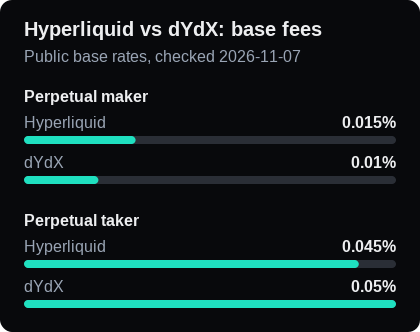
Hyperliquid has the lower perpetual taker fee: 0.045% against 0.05% at dYdX. Standard-tier rates, checked 2026-11-07.

Hyperliquid

Spot fee gap, percentage points

Not yet checked

Spot fee gap, percentage points: Not yet checked

dYdX

Hyperliquid: 0.015%Perp makerdYdX: 0.01%
Hyperliquid: 0.045%Perp takerdYdX: 0.05%
Hyperliquid: 0.04% / 0.07%SpotdYdX: Not yet checked

Bars share one scale across every venue, 0 to 0.80%

Calculate your savings in USDT

dYdX vs Hyperliquid: who has lower fees?

  • HyperliquidPartner rebate share: Up to 30%
  • dYdX
See which one fits you

Which perpetual fee is lower?

For base perpetual fees checked 2026-11-07, dYdX favours makers at 0.01% against Hyperliquid’s 0.015%; Hyperliquid favours takers at 0.045% against dYdX’s 0.05%. Your execution role changes the answer. Confirm the applicable volume tier and contract before trading, then account for funding and network costs separately from these commissions.

Line by line

Best for

Best for lowest checked fees
Hyperliquid

Verified spot taker; maker breaks ties.

Best for futures
Hyperliquid

Choose the lowest checked futures taker fee, then maker fee; funding matrix participation is descriptive only.

Best for beginners (funding / fee proxy)
Hyperliquid

Reviewed local funding guide first, then lowest spot fee.

Show rules, dates and sourcesHide rules, dates and sources

Scroll horizontally to compare all exchanges

Published data only. Fees are maker / taker, in percent. A venue with no published figure is left out of that row, and equal figures count as a tie.
DimensionHyperliquiddYdX
Fees
Lowest checked spot feesVerified spot taker; maker breaks ties.0.04% / 0.07%WinnerAs of 2026-11-07 SGTHyperliquid fee scheduledocs.dydx.xyz
Lowest checked futures feesVerified futures taker; maker breaks ties.0.015% / 0.045%WinnerAs of 2026-11-07 SGTHyperliquid fee schedule0.01% / 0.05%As of 2026-10-10 SGTdocs.dydx.xyz
Coins & products
Funding-rate matrix participationShows participation in the reviewed funding-matrix universe; no live observed pair count is inferred.Included in funding-rate matrixNexuAlpha /funding-ratesOutside the reviewed funding matrixNexuAlpha /funding-rates
Best for futuresFutures evidence comes from checked futures fee facts.YesTieAs of 2026-11-07 SGTHyperliquid fee scheduleYesTieAs of 2026-10-10 SGTdocs.dydx.xyz
Hyperliquid vs dYdX · Perpetual maker / taker fee: Hyperliquid 0.015% / 0.045%, dYdX 0.01% / 0.05%
Chart source: NexuAlpha reviewed data ·

Fees, Rebates, Reserves & Limits Comparison

Each row links its official source; anything unchecked is marked.

Hyperliquid: Fees checked 2026-11-07 · dYdX: Fees checked 2026-10-10

Swipe the matrix sideways to compare all columns.

Side-by-side numbers
Hyperliquid
Perp DEX
dYdX
Perp DEX
Spot maker / taker feeStandard spot trading fees
0.04% / 0.07%Regular userDated public base rate; account terms can differ. View fee source ↗
Not yet checkedDated official maker/taker rates only.
Futures maker / taker feeStandard perpetual futures fees
0.015% / 0.045%Regular userDated public base rate; account terms can differ. View fee source ↗
0.01% / 0.05%Regular userDated public base rate; account terms can differ. View fee source ↗
Proof of Reserves (PoR)Merkle-tree reserve verification
Official page linked, figures not yet reviewedView audit report · hyperliquid.xyz
Official page linked, figures not yet reviewedView audit report ↗
Official actionCheck official account terms and sources

Who has lower fees?

On perpetual fees, neither venue wins both maker and taker fees (Hyperliquid 0.015% / 0.045%; dYdX 0.01% / 0.05%, maker / taker). This is a perpetual-execution decision: dYdX has the lower recorded maker rate, while Hyperliquid has the lower taker rate. There is no winner across both execution types. A resting-order strategy should examine dYdX's maker side; an aggressive strategy should examine Hyperliquid's taker side. Compare collateral movement and funding before moving a position.

Hyperliquid
Who it fits
On-chain order-book Perp DEX for users who can verify Hyperliquid fees, funding payments, USDC funding, sub-account gates, API-wallet signing and liquidation margin before trading.
Verify first
Collateral and liquidation rules / Oracle and funding mechanics

Partner rebate share: Up to 30%

dYdX
Who it fits
Veteran on-chain perpetual pioneer, Cosmos sovereign appchain architecture with fully open-source decentralized matching.
Verify first
Collateral and liquidation rules / Oracle and funding mechanics
Sources and decision notes
Product context
On perpetual fees, neither venue wins both maker and taker fees (Hyperliquid 0.015% / 0.045%; dYdX 0.01% / 0.05%, maker / taker). These are checked base-fee snapshots; verify account tiers, token discounts, rebates, funding and regional eligibility in the official account. Compare Hyperliquid and dYdX by execution model, fee schedule, funding cadence, collateral, liquidation logic, oracle design, wallet-signing route, network dependency, regional limits and official documentation. A lower quoted cost or faster interface does not remove liquidation, bridge, outage or eligibility risk.
Spot low-fee verdict
This is a perpetual-execution decision: dYdX has the lower recorded maker rate, while Hyperliquid has the lower taker rate. There is no winner across both execution types.
Futures verdict
A resting-order strategy should examine dYdX's maker side; an aggressive strategy should examine Hyperliquid's taker side. Compare collateral movement and funding before moving a position.
P2P / fiat by country
For a US resident, a wallet connection is not evidence of permitted access. Read each protocol's current frontend restrictions; these snapshots do not establish US eligibility or a fiat on-ramp.
Beginner verdict
Practice collateral transfers and wallet recovery before opening leverage. A beginner seeking a fiat spot purchase should start with that requirement rather than choosing between these perp interfaces.
What differs · Hyperliquid vs dYdX
Hyperliquid and dYdX do not both have a checked spot maker-and-taker record. Hyperliquid was checked on 2026-11-07. A missing schedule remains unpriced.
Fee tiers, discounts and tracked listings · Hyperliquid vs dYdX
Hyperliquid unknown: 0.0400% maker / 0.0700% taker, checked 2026-11-07; dYdX no checked spot tier: no checked spot fee. In the 199-asset CEX sample checked 2026-10-12, Hyperliquid covers 0 spot and 0 perpetual listings in the baked CEX coin sample and dYdX covers 0 spot and 0 perpetual listings in the baked CEX coin sample.
Spot · $1,000 worked example
$1,000 single fill: Hyperliquid maker $0.40, taker $0.70 (snapshot 2026-11-07); dYdX: not yet checked. A two-sided fee difference is not yet checked.
Spot · $5,000 worked example
$5,000 single fill: Hyperliquid maker $2.00, taker $3.50 (snapshot 2026-11-07); dYdX: not yet checked. A two-sided fee difference is not yet checked.
Spot · $10,000 worked example
$10,000 single fill: Hyperliquid maker $4.00, taker $7.00 (snapshot 2026-11-07); dYdX: not yet checked. A two-sided fee difference is not yet checked.
Futures · $1,000 worked example
$1,000 single fill: Hyperliquid maker $0.15, taker $0.45 (snapshot 2026-11-07); dYdX maker $0.10, taker $0.50 (snapshot 2026-10-10). Absolute difference: maker $0.05, taker $0.05.
Futures · $5,000 worked example
$5,000 single fill: Hyperliquid maker $0.75, taker $2.25 (snapshot 2026-11-07); dYdX maker $0.50, taker $2.50 (snapshot 2026-10-10). Absolute difference: maker $0.25, taker $0.25.
Futures · $10,000 worked example
$10,000 single fill: Hyperliquid maker $1.50, taker $4.50 (snapshot 2026-11-07); dYdX maker $1.00, taker $5.00 (snapshot 2026-10-10). Absolute difference: maker $0.50, taker $0.50.
Withdrawal fee difference
No comparable coin-and-network withdrawal quote is checked for Hyperliquid vs dYdX; compare one asset and network, then check the net amount received.
Example scope
Examples use dated public base rates for one USD-equivalent fill. Account terms, discounts, spread, slippage, funding and withdrawal costs can change the total for Hyperliquid vs dYdX.
Hyperliquid spot source conditions
Tier 0 base rate (14-day volume ≤ $5M), before staking/referral discounts. Official docs, read 2026-11-07.
Hyperliquid futures source conditions
Tier 0 perps base rate. Official docs, read 2026-11-07.
dYdX futures source conditions
Tier 1 (< $1M 30-day volume): taker 5.0 bps, maker 1.0 bps. Official docs; schedule set by governance. Read 2026-10-10.

This comparison cannot confirm wallet access, regional eligibility, liquidation risk, bridge safety or final trading cost.
Review fees, reserves and KYC
Trading platform deep comparison

Hyperliquid

Perp DEX
Review fees, reserves and KYC
Spot Fee0.04% / 0.07% (maker / taker) · Regular user · Base rate from the official fee pageDated public base rate; account terms can differ. View fee source ↗
Hyperliquid Official References & Sources
Hyperliquid Official References & SourcesRead terms and sources →
  • •A valid referral code or link must be applied. This research panel does not include referral codes; the sign-up cards on this site do.
  • •The fee discount stops after the referred account's first $25 million in volume; vaults and sub-accounts do not inherit it.
Side-by-side numbers
Compare firstHyperliquid vs dYdX

Read the differences first, then decide which venue deserves the registration path.

Must verify before registrationRegion · product · account tier

Verify eligibility before the official flow

Next stepOpen independent profile

Only verified links open, each to the official site.

Open scenario fit and next steps

Pre-registration verdict

Decide which venue fits first

HyperliquidPerp DEX
Review verification details and limits
Better for
Verify public products, regional eligibility and official fees first
Before registration
Only source-linked facts with a review date are publishable
Not ideal for
Regional restrictions, account eligibility and campaign terms need official verification
Consider instead
dYdX
Open independent profile
dYdXPerp DEX
Review verification details and limits
Better for
Verify public products, regional eligibility and official fees first
Before registration
Only source-linked facts with a review date are publishable
Not ideal for
Regional restrictions, account eligibility and campaign terms need official verification
Consider instead
Hyperliquid
Open independent profile
PRE-SIGNUP DECISION CHECKLIST

Which conditions should you compare?

Check fees, access and account terms first.

Hyperliquid
Candidate A
  • Published fee reference: Spot 0.04% / 0.07% (maker / taker) · Regular user · Base rate from the official fee page, Futures 0.015% / 0.045% (maker / taker) · Regular user · Base rate from the official fee page; Dated official maker/taker rates only.
dYdX
Candidate B
  • Published fee reference: Spot Fee pending official-source verification, Futures 0.01% / 0.05% (maker / taker) · Regular user · Base rate from the official fee page; Dated official maker/taker rates only.

Which platform fits your trading?

A trader who mainly provides perpetual liquidity sees a lower checked maker charge at dYdX, while a trader who mainly takes liquidity sees a lower checked taker charge at Hyperliquid. Spot access makes the choice sharper: the dYdX record explicitly says spot is not offered. There is no sensible single fee winner without describing the intended trade.

Verdict by user type
User typePreferenceWhy
Resting perpetual ordersdYdXdYdX records 0.01% maker against Hyperliquid at 0.015%, under the respective documented entry schedules.
Aggressive perpetual ordersHyperliquidHyperliquid records 0.045% taker versus dYdX at 0.05%, before any conditional discounts or rewards.

How to read the fee comparison

The two fee tiers use different volume frameworks, so this comparison preserves each base row rather than claiming account-tier equivalence. Hyperliquid’s spot schedule is available separately; dYdX’s absent spot row means the market is not offered in this record, rather than an unchecked free price. The dYdX fee hub should keep that distinction explicit. Rewards, staking effects, funding and collateral-transfer costs are not netted against the displayed trading commissions.

Key differences

  • dYdX has the lower checked perpetual maker charge, favouring successfully resting orders on this fee dimension.
  • Hyperliquid has the lower checked perpetual taker charge, so aggressive execution reverses the maker ranking.
  • Hyperliquid has checked spot fees, whereas the dYdX product record explicitly marks spot as unavailable.
  • Both venues are classified as perpetual DEXs, but that shared category does not prove identical wallet or collateral workflows.
  • The dYdX source describes a governance-set schedule; conditional benefits must be checked independently rather than assumed permanent.

Who should avoid this choice?

A spot buyer should avoid treating dYdX’s missing spot rate as an opportunity: the source records no spot market. A trader who submits resting orders but frequently crosses the book should avoid modelling their entire activity at the maker rate. Someone choosing between these workflows should verify account access, collateral handling and recovery procedures before moving funds.

FAQ & decision checks

Fees, product access and account checks

Questions for comparing these venues.

dYdX vs Hyperliquid: who has lower fees?
On perpetual fees, neither venue wins both maker and taker fees (Hyperliquid 0.015% / 0.045%; dYdX 0.01% / 0.05%, maker / taker). This is a perpetual-execution decision: dYdX has the lower recorded maker rate, while Hyperliquid has the lower taker rate. There is no winner across both execution types. A resting-order strategy should examine dYdX's maker side; an aggressive strategy should examine Hyperliquid's taker side. Compare collateral movement and funding before moving a position.
Which risk check matters first on Hyperliquid vs dYdX?
Start with collateral and liquidation. Confirm what asset backs the position, how margin is maintained, how liquidations are triggered, what oracle or price source is used and what happens if the wallet, network, indexer or front end is unavailable.
Is Hyperliquid vs dYdX a no-KYC comparison?
Only partly. Wallet connection can reduce account friction, but no-KYC access still depends on front-end availability, regional restrictions, sanctions controls, product rules, wallet screening and current official terms. Treat it as an access-risk comparison, not an eligibility promise.
Should funding rates decide the platform choice?
Funding is one input, not the whole decision. Compare funding cadence, maker and taker fees, liquidity, collateral movement, liquidation rules, oracle route, withdrawal path and operational recovery before choosing a perpetual venue.
Should I read the news explainer or this comparison page?
Use the news article for the dated source-reading explainer. Use this comparison page for the current decision checklist across fees, funding, collateral, liquidation, wallet route, account access and operational recovery.
What dYdX onboarding detail belongs beside the fee comparison?
Check dYdX onboarding, wallet screening, regional access, bridge route and withdrawal path beside fees and funding. Those source checks can change whether a wallet-connected route is usable before the trade cost is even relevant.
Which side of the Hyperliquid–dYdX tradeoff matters for a stop exit?
A stop that executes against resting liquidity should be budgeted at the taker rate. Lower maker pricing on an entry does not establish the cost of an emergency exit, bridge or collateral withdrawal.
What do $1,000 and $10,000 trades cost on Hyperliquid vs dYdX?
$1,000 single fill: Hyperliquid maker $0.40, taker $0.70 (snapshot 2026-11-07); dYdX: not yet checked. A two-sided fee difference is not yet checked. $5,000 single fill: Hyperliquid maker $2.00, taker $3.50 (snapshot 2026-11-07); dYdX: not yet checked. A two-sided fee difference is not yet checked. $10,000 single fill: Hyperliquid maker $4.00, taker $7.00 (snapshot 2026-11-07); dYdX: not yet checked. A two-sided fee difference is not yet checked. $1,000 single fill: Hyperliquid maker $0.15, taker $0.45 (snapshot 2026-11-07); dYdX maker $0.10, taker $0.50 (snapshot 2026-10-10). Absolute difference: maker $0.05, taker $0.05. $5,000 single fill: Hyperliquid maker $0.75, taker $2.25 (snapshot 2026-11-07); dYdX maker $0.50, taker $2.50 (snapshot 2026-10-10). Absolute difference: maker $0.25, taker $0.25. $10,000 single fill: Hyperliquid maker $1.50, taker $4.50 (snapshot 2026-11-07); dYdX maker $1.00, taker $5.00 (snapshot 2026-10-10). Absolute difference: maker $0.50, taker $0.50. Examples use dated public base rates for one USD-equivalent fill. Account terms, discounts, spread, slippage, funding and withdrawal costs can change the total for Hyperliquid vs dYdX.
Which withdrawal is cheaper for Hyperliquid vs dYdX?
No comparable coin-and-network withdrawal quote is checked for Hyperliquid vs dYdX; compare one asset and network, then check the net amount received.
How should a fiat beginner choose between Hyperliquid and dYdX?
For a US resident, a wallet connection is not evidence of permitted access. Read each protocol's current frontend restrictions; these snapshots do not establish US eligibility or a fiat on-ramp. Practice collateral transfers and wallet recovery before opening leverage. A beginner seeking a fiat spot purchase should start with that requirement rather than choosing between these perp interfaces.
Hyperliquid or dYdX: which perpetual fee is lower?
For base perpetual fees checked 2026-11-07, dYdX favours makers at 0.01% against Hyperliquid’s 0.015%; Hyperliquid favours takers at 0.045% against dYdX’s 0.05%. Your execution role changes the answer. Confirm the applicable volume tier and contract before trading, then account for funding and network costs separately from these commissions.
Which venue is cheapest for a mixed strategy?
That depends on the actual share of maker and taker fills. The checked rankings point in different directions, so a blanket winner would conceal the trade-off.
Can I buy spot on both?
The supplied record establishes spot on Hyperliquid and explicitly records no spot market on dYdX.
Do rewards cancel trading fees?
This comparison makes no reward assumption. A reward is conditional and should be evaluated separately from a charged commission.
Where can I inspect Hyperliquid’s counterpart?
Use the Hyperliquid comparison hub to distinguish the spot schedule from the perpetual base row.
Before you register
Must verify before registration

Compare the details

Compare the detailsHyperliquiddYdX
Products

Hyperliquid docs describe HyperCore as including fully on-chain perpetual futures and spot order books.Read source ↗

HIP-3 documentation says the protocol supports permissionless builder-deployed perpetuals.Read source ↗

Not documented in this research
Fees

Hyperliquid fees documentation says fees are based on rolling 14 day volume, assessed at the end of each UTC day, with separate schedules for perps and spot; sub-account volume counts toward the master account fee tier while vault volume is treated separately.Read source ↗

A Hyperliquid fees search should split cost evidence into four official lanes: the fee schedule for maker/taker tiers, funding docs for hourly peer-to-peer funding, contract specifications for market mechanics, and liquidation docs for maintenance-margin failure paths.Read source ↗

Hyperliquid funding docs say funding is peer-to-peer, collected by neither side of the venue, paid every hour, and based on the difference between the perpetual contract price and the spot oracle price.Read source ↗

A Hyperliquid fees query should be read as a bundle: maker/taker schedule, hourly funding, margin mode and liquidation threshold can all change the position cost before PnL is known.Read source ↗

Before placing a Hyperliquid perp order, compare the quoted maker/taker tier, expected hourly funding direction, margin mode, maintenance margin, liquidation path, bridge or USDC movement cost, and whether the order belongs to main account, sub-account or API wallet flow.Read source ↗

Hyperliquid combines perp and spot volume into one fee tier, with spot volume counting double in the published 14-day weighted-volume formula; the applicable maker or taker rate still depends on the current official tier and asset context.Read source ↗

HIP-3 perpetuals share the user's fee tier, but growth mode and deployer-configured fee shares can change all-in fees, rebates and volume contribution. Users should verify the specific HIP-3 market instead of applying one protocol-wide perp rate.Read source ↗

Not documented in this research
Custody

Hyperliquid USDC docs describe native Hyperliquid L1 USDC and point users to Circle's Arbitrum-to-HyperCore CCTP transfer documentation.Read source ↗

Hyperliquid exchange-endpoint docs separate signed trading actions from user-signed Core USDC transfers, so wallet movement cost and transfer signing should be checked separately from maker/taker fees and funding.Read source ↗

Hyperliquid account-abstraction docs separate unified, portfolio margin and manual/standard modes, which determine how spot and perps balances interact and whether assets are used as perps collateral.Read source ↗

Not documented in this research
Account & access

Hyperliquid testnet faucet docs say users need a mainnet deposit with the same address before receiving mock USDC for testnet use.Read source ↗

A Hyperliquid funded-account search should be split into wallet funding, USDC collateral, account modes, sub-accounts and API-wallet delegation; the official docs do not turn that phrase into a guaranteed prop-account allocation.Read source ↗

For a Hyperliquid funded-account query, use USDC docs for funding the wallet, account-abstraction docs for collateral mode, sub-account docs for account separation, API-wallet docs for delegated signing, and vault docs for vault participation; none of those sources proves a third-party prop account allocation.Read source ↗

When the query is 'Hyperliquid funded account', NexuAlpha should not collapse wallet collateral, sub-accounts, vault deposits and outside prop-firm language into one CTA; each meaning requires a different official source check.Read source ↗

Hyperliquid sub-account docs say up to 10 sub-accounts can be created only after reaching $100,000 in volume, and referral discounts do not apply to sub-accounts.Read source ↗

Hyperliquid API wallet docs say API wallets sign on behalf of a master account or sub-account, but account data queries must use the actual account address, not the agent wallet.Read source ↗

Not documented in this research
Execution

Hyperliquid liquidation docs say liquidation begins when account equity falls below maintenance margin, which varies by asset and maximum leverage.Read source ↗

dYdX docs say each v4 full node maintains an in-memory order book and validators propose matched trades into blocks.Read source ↗

dYdX funding docs state funding rates are used to keep perpetual market prices close to oracle prices.Read source ↗

DimensionHyperliquiddYdX
Verified official domainapp.hyperliquid.xyzdydx.trade

Continue research

Open platform detail links
Open curated platform comparison paths
CURATED PLATFORM COMPARISONSReview fees, products and regional conditions by source date

Only verified links open, each to the official site.

Guides for Hyperliquid / dYdX

{name} research updates.
  1. Binance Adds 5 bStocks as Margin Collateral and Extends Zero Maker Fees as Bitget, KuCoin, and Bybit Expand Stock Perps
  2. Binance Cuts US Stock Trading Platform Fee by 51% to $0.17 With VIP Tiers as SOXLUSDT Drops 28.6% and $193.8M Liquidates
  3. Hyperliquid Fees: 0.015% to 0.045% Perps, 0.04% to 0.07% Spot, HYPE Staking, and Real 30-Day Funding Costs
  4. Bitget Fees: 0.10% Spot, 0.02% to 0.06% Futures, 60% Daily Return, and Real 30-Day Funding Costs

How we check feesEditorial policyCorrections